The Blueprint of Less: An Interactive Guide to Designing a High-Focus Life and Environment

We live in a world that treats accumulation like a religion. From the moment we step into the modern marketplace, we are hit with non-stop noise telling us to do more, buy more, say more, and pack our schedules with endless variables. We accumulate digital subscriptions we don’t watch, clutter our workspaces with objects we don’t need, and build overly complicated daily routines that leave us completely overwhelmed before noon. In behavioral and cognitive psychology, this is known as additive bias—the natural human tendency to solve problems by adding new elements rather than stripping away what isn’t working.
When you constantly add features to your lifestyle, your focus doesn’t scale; it fractures. Your brain consumes precious cognitive fuel filtering out background clutter. When Apple icon Steve Jobs famously declared that “Simplicity is the ultimate sophistication,” he wasn’t just talking about the aluminum casing of a laptop. He was laying down a radical, actionable framework for life. True sophistication isn’t about adding decorative layers to hide flaws; it is about refining an environment or a routine until only what is vital remains.
This interactive tutorial is your structural guide to running an environment and lifestyle edit. By using physical design principles like those found in modern minimalist art, you can manually lower your mental load, maximize your daily focus, and turn your home into a protective sanctuary against outside noise.
Module 1: The Desktop & Digital Workspace Audit (Time: 15 Minutes)
Your visual cortex is constantly scanning your field of vision, even when you think you are laser-focused on a single task. If your physical desk is cluttered with loose papers, old mugs, and tangled cords, or if your digital computer desktop is covered in random, unorganized files, your brain is actively working overtime to process that clutter.
Action Steps:
- The Clear-Cut Sweep: Physically remove everything from your primary desk except your computer, your mouse, and your keyboard. Place all stray notebooks, pens, and loose items into a single cardboard box on the floor.
- The 3-Item Rule: Look inside the box. You are only allowed to bring back three high-utility items that you use every single hour (e.g., a dedicated water bottle, a single notebook, and one quality pen). Everything else stays hidden inside a drawer or cabinet out of your direct line of sight.
- The Digital Bin: Create a single folder on your computer desktop and name it “Archive [Today’s Date]”. Highlight every single loose document and screenshot scattered across your screen and drag them into that one folder. Your desktop should be a clean, open expanse of negative space.
Interactive Self-Check:
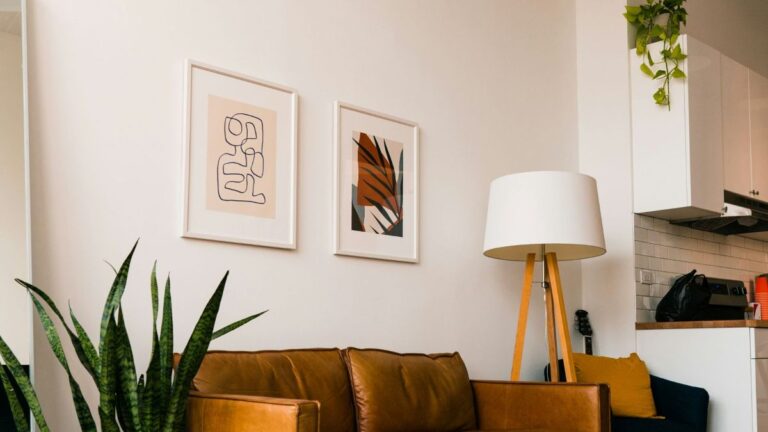
Look at your newly cleared desk workspace right now. Take one deep breath. Notice how the physical emptiness instantly lowers the tension in your shoulders? That is the immediate psychological ROI of a minimalist line art print layout in real life.
Module 2: Curating Your Environmental Cues (Time: 20 Minutes)
Your mind relies heavily on spatial context. If a room has no visual anchors, or if it’s packed with conflicting, bright decorations, your attention span remains scattered. To build deep focus, you need to turn your walls into functional boundaries.
Action Steps:
- Locate the Friction Wall: Walk through your home or office and identify the one wall you look at most frequently when you are experiencing stress, fatigue, or creative blocks (usually directly behind your computer setup or across from your favorite chair).
- The Environmental Edit: Strip away any busy calendars, old corkboards, or generic decorations from that wall. Leave it completely blank for a moment to let the spatial energy settle.
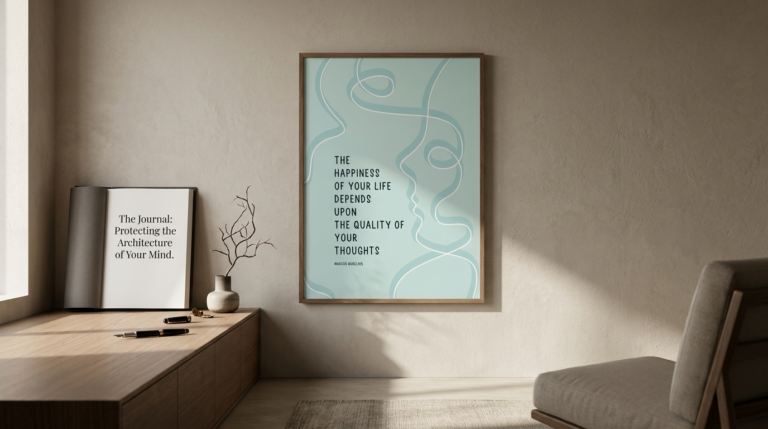
- The Anchor Placement: Hang a single, high-contrast typography print—like our “Simplicity is the Ultimate Sophistication” layout—or an organic abstract piece. This acts as a visual rest station. When your eyes drift during a intense problem-solving session, they hit a grounding truth instead of chaotic visual noise.
[MINIMALIST GALLERY WALL SETUP DIAGRAM]
-------------------------------------------------------
|                                                     |
|       [ Clean, High-Contrast Typography Print ]       |
|            "Simplicity is Sophistication"           |
|                                                     |
|   -----------------------------------------------   |
|   |         Minimalist Desk Ledge Surface       |   |
|   -----------------------------------------------   |
-------------------------------------------------------
   (Wide negative space margins to lower cognitive load)
Interactive Self-Check:
- Does your current room decor inspire a sense of stillness, or does it feel like a visual to-do list?
- Action: If a wall hanging doesn’t actively clarify your thoughts, remove it today. Replace it with clean boho wall decor or purposeful quotes in frames that remind you to breathe.
Module 3: The “Subtractive” Priority Grid (Time: 10 Minutes)
Most productivity toolkits fail because they focus on helping you get more things done. True sophistication requires choosing what to leave undone so that your best energy goes to your highest-value work.
Action Steps:
Copy this exact grid onto a blank note or paper right now to execute your daily time-edit:
| Keep (The Vital Few) | Cut (The Noise) | Automate / Delegate |
| 1. Max 2 critical needle-movers | 1. Low-impact text threads | 1. Repetitive email templates |
| 2. Deep creative strategy | 2. Routine comparison scrolling | 2. Scheduling automation |
- Write Your To-Do List: List out everything you think you need to accomplish today.
- Apply the Subtraction Knife: Intentionally cross off the bottom 30% of that list. Push those tasks to next week or delete them entirely. If a task doesn’t actively protect your core mission, it is noise masquerading as progress.
- Protect Your Margin: Block out 60 minutes in your calendar where you are completely unreachable. No email checks, no phone responses, no conversations. Use this time to build your primary work with absolute, uncompromised intent.
Final Application Matrix
Simplicity is not a passive aesthetic layout you admire from a distance; it is an active discipline you apply to your environment, your schedule, and your mind every single morning. The next time you find yourself spiraling into overwhelm, do not seek a new app, a new tool, or a new task to fix the problem. Look around your room, look at your calendar, and ask yourself the golden design question:
“What can I strip away right now to let the true masterpiece breathe?”
Clear out the clutter, frame your life with absolute intention, download your visual reminders, and allow yourself to move through your goals with the absolute sophistication of less today.